Pearson Edexcel · GCSE · Computer Science
Course version: 1CP2 · Version from Sept 2020
Be able to write programs that use arithmetic operators (addition,…
Full specification wording
Operators: 6.5.1 be able to write programs that use arithmetic operators (addition, subtraction, division, multiplication, modulus, integer division, exponentiation)
This criterion requires you to write working program code, not merely name operators.
Checked against the Pearson Edexcel 1CP2 specification (opens in a new tab) on .
- Point 1 of 3
- 4 key terms
Study notes
From the checked teaching notes for this specification point.
The idea
This criterion requires you to write working program code, not merely name operators. In a language such as Python, addition combines values (total = price + tax), subtraction finds a difference (change = paid - cost), multiplication scales (area = width * height) and division produces a quotient (mean = total / count). Modulus returns the remainder (remainder = value % 7), which is useful for testing divisibility or wrapping values. Integer division discards the fractional part (whole = total // count), giving how many whole times one number fits into another. Exponentiation raises a base to a power (area = side ** 2 for a square, volume = side ** 3 for a cube). Choose the operator that matches the required output, apply it to the correct operands, and check the result with a test value.
What earns the marks
- Selects the correct arithmetic operator for a stated purpose, for example addition to combine two quantities or multiplication to scale a value.
- Writes a complete expression in which every operator has both operands, such as total = price + tax or area = side ** 2.
- Distinguishes modulus from integer division: modulus yields the remainder, while integer division yields the number of whole times one value fits into another.
- Uses exponentiation for powers, for example side ** 2 for a square's area and side ** 3 for a cube's volume, rather than repeated multiplication written incorrectly.
- Applies the correct order of operations or uses brackets so that a compound expression evaluates as intended.
- Tests the program with sample inputs and confirms the output matches a hand-calculated result.
Common mistakes and how to put them right
Confusing modulus with integer division.
Put it right: Modulus returns the remainder, so 17 % 5 gives 2, while integer division 17 // 5 gives 3.
Writing an expression in which an operator has only one operand, which is a syntax error.
Put it right: Every operator needs a value on each side, so write the full expression with both operands present.
Assuming ordinary division always produces a whole number.
Put it right: Ordinary division can produce a fractional result, so use integer division when a whole-number quotient is required.
Using exponentiation when simple multiplication is intended, or vice versa.
Put it right: Match the operator to the mathematical meaning, using exponentiation only for raising a base to a power.
Exam tips
- Read the question's required output first, then choose the operator whose result matches that output rather than the operator that looks familiar.
- Trace a short expression with small numbers by hand before selecting an answer, so the predicted result can be compared with each option.
- Check each candidate expression for completeness: every operator must have a value on both its left and its right.
- When two options differ only in one operator, evaluate both with the same sample numbers and compare the results.
Try the lesson
The start of the Operators: 6.5.1 be able to write programs that use arithmetic operators (addition, subtraction, division, multiplication, modulus, integer division, exponentiation) lesson, made from checked teaching notes for this specification point.
Have a go first
A program contains the statement remainder = 17 MOD 5, where MOD returns the remainder left after dividing the left operand by the right operand. What value is stored in remainder?
Listen
This criterion requires you to write working program code, not merely name operators. In a language such as Python, addition combines values (total = price + tax), subtraction finds a difference (change = paid - cost), multiplication scales (area = width * height) and division produces a quotient (mean = total / count). Modulus returns the remainder (remainder = value % 7), which is useful for testing divisibility or wrapping values. Integer division discards the fractional part (whole = total // count), giving how many whole times one number fits into another. Exponentiation raises a base to a power (area = side 2 for a square, volume = side 3 for a cube). Choose the operator that matches the required output, apply it to the correct operands, and check the result with a test value. A strong answer earns marks for these points. Selects the correct arithmetic operator for a stated purpose, for example addition to combine two quantities or multiplication to scale a value. Writes a complete expression in which every operator has both operands, such as total = price + tax or area = side 2. Distinguishes modulus from integer division: modulus yields the remainder, while integer division yields the number of whole times one value fits into another. Uses exponentiation for powers, for example side 2 for a square's area and side 3 for a cube's volume, rather than repeated multiplication written incorrectly. A common slip: Confusing modulus with integer division: the learner expects the whole-number quotient from the modulus operator. Instead, modulus returns the remainder, so 17 % 5 gives 2, while integer division 17 // 5 gives 3. Exam tip: Read the question's required output first, then choose the operator whose result matches that output rather than the operator that looks familiar.
See it

Key words
Say what each word means before you turn the card.
Modulus
Try answering aloud or in your head before turning the card.
Integer division
Try answering aloud or in your head before turning the card.
Exponentiation
Try answering aloud or in your head before turning the card.
Operands
Try answering aloud or in your head before turning the card.
See every definition
- Modulus
- Returns the remainder, which is useful for testing divisibility or wrapping values.
- Integer division
- Discards the fractional part, giving how many whole times one number fits into another.
- Exponentiation
- Raises a base to a power, for example side ** 2 for a square's area and side ** 3 for a cube's volume.
- Operands
- Every operator needs a value on each side, so a complete expression has both present.
Label the diagram
Some boxes have lost their names. Pick the right name for each number.
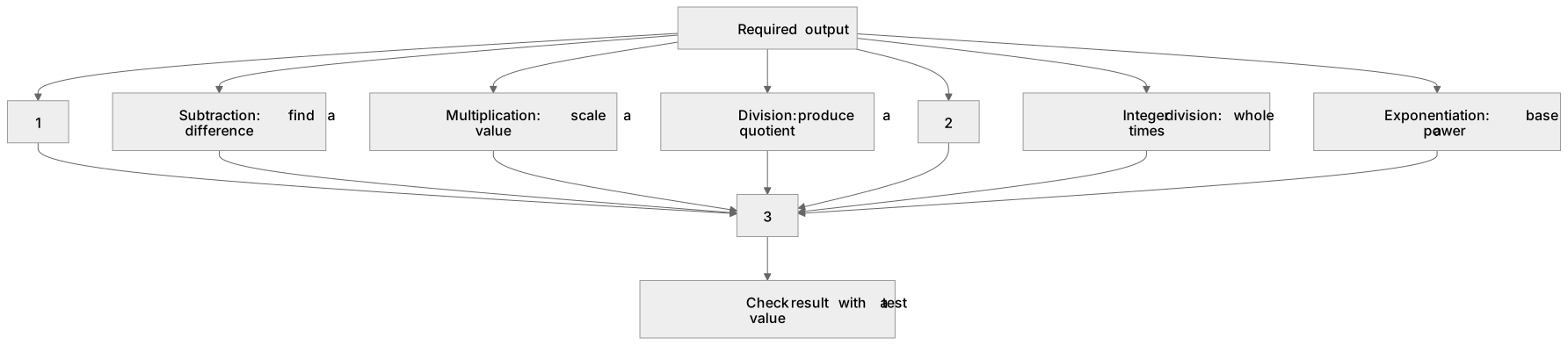
1Box 1
2Box 2
3Box 3
There is more to this lesson
The full lesson goes on to check your understanding and help you earn the marks. Create a free account to carry on, with your progress saved.
A week of Premium from your first lesson · Then the free plan continues · No card, no charge
Test your understanding of Operators: 6.5.1 be able to write programs that use arithmetic operators (addition, subtraction, division, multiplication, modulus, integer division, exponentiation)
Active recall beats re-reading. Take an instant quiz now to test what you’ve learned and lock it into long-term memory.
A week of Premium from your first lesson · Then the free plan continues · No card, no charge